Showing posts with label Hobby Commentary. Show all posts

Monday, September 6, 2021

Train show tips


 I've decided to go ahead and attend the train show in Simpsonville this coming Saturday. It'll be the first show I've been to in the better part of two years. I've going to train shows since I was kid and I've even helped run a bunch with old club up in New York. I that spirit, I've decided to give you some of my tips and advice.

1. Have budget and stick to it.

2. Have an idea of what you want. For example, I'll be on the hunt for buildings and maybe some freight cars. Knowing what you want makes easier to stay on budget and avoid buyer's remorse.

3. Don't buy the first thing that catches your eye. Browse the whole show first. Yeah, you risk missing on that first thing but, if you do buy it, you risk missing out out on something may have wanted more.

4. The best merchandise is there at the beginning of the day, the deals happen at the end. This is an obvious trade off. All the good stuff is there at the start, but so are all eager buyers. At the end of the day, dealers are going to be tired, and more willing to make a deal so they don't have to lug the stuff home.

5. Do your homework. Say a dealer has that new engine you've been looking for. If you've checked several retailers before the show, you'll know if you're getting a good deal or not. Or, you can always use your phone to check the price. Do that discreetly, however.

6. If you're buying a locomotive, try before you buy. Most trains shows have a test track. If the dealer doesn't want you testing it, that's a big red flag.

7. Get business cards, flyers, and receipts. Maybe the dealer has an online shop. Also if your engine is a lemon, you'll want some recourse.

8. This is my most important piece of advice, Don't be afraid to leave empty handed. I get it, you got up early, drove a good distance and paid the admission only to not find what you're looking for. It sucks. The worst thing to do is buy something just to buy something. It's a sure-fire recipe for buyer's remorse. Sometimes the best train show deal is leaving with your money in pocket.

Sunday, May 17, 2020

Knowing when to say when

Wow! It's six months since my last entry! I supposed you're wondering where I've been. Well, I'm going to tell you anyway. For one thing, having a three and five-year-old means when I have the time to work on the layout, I don't have the energy. Conversely, when I have energy, I don't have time.

On top of that, I'm just getting kind of bored model railroading. Most of the layout is done now. and I'm just not motivated to finish the remaining project. Mostly I just find myself running the trains. Throw in my writing and my newly-acquired 1965 Chevy Corvair, there's just not much time for trains anymore.

   
Go ahead, ask me if I've read Ralph Nader's book. I dare you!
And now, onto the real subject of this blog post. We've all been there, it's late at night and the locomotive you're trying to install a decoder in just won't run. You know the darn thing is hooked up right, so why won't it go. You're tired and part of you knows you should call it a night. But you wonder when you're going to have the time or when the house will be this quiet again. So you keep on fighting, getting nowhere. Then pop! The decoder smokes, you fried it.

Folks, I can't tell you how many small problems I've turned into catastrophes because I didn't know when to say "when." It's easier said than done. When you're frustrated, you want to fix it right then and there. But, more often than not stepping away and coming back to it later can give you a fresh perspective. You may find a solution you couldn't when you were tired and frustrated.

So that's my two cents worth. I'm sure I'll be back to work on the layout at some point. I just don;t know when.

Tuesday, January 23, 2018

Train Room Safety

Alright, I'm about to sound like a nagging mother but, raise your hand if you've done any of the following: used spray paint or Dulcote inside without a respirator, cut Styrofoam with a hot knife or wire without adequate ventilation, used acetone to clean your hands after a messy painting project, used solder and flux in a confined space, used a Dremel without eye protection and the list goes on. My hand went up for all of them.

Where am I going with this? Well, last march (2017) I attended the wedding of a very dear friend from college. Two years prior this friend was diagnosed with Adenoid Cystic Carcinoma, a very rare, but treatable, cancer. Thankfully, my friend beat it and is now cancer free. However, without going into too much detail, there were lingering effects of the treatment, which as I write this, she is currently in surgery to help correct.

Seeing her at her wedding was a bit of a wake up all for me. For a while one of my guilty pleasures was taking my copy of Model Railroader out to the back porch and reading it while enjoying a cold beer and a cigar. I knew it wasn't the best thing for my health, but when I got home from the wedding, I opened my humidor and dumped all my cigars into the trash. I haven't smoked one since.

Then I started thinking about all the things I mentioned in the top paragraph, and how they weren't the smartest things to be doing. So I instituted a few new safety rules for the train room.

To whit:

1. All spray painting and Dulcote is done in the garage with the door open.

2. The same goes for cutting foam with hot knives and such.

3. If doing the above in the train room can't be helped, then I open the window and get a few fans blowing first.

4. I'm trying to limit my use solvent-based Floquil and Polyscale paints. Not only because of the fumes, but because as we all know, they're no longer made and when they're gone, they're gone.

5. Eye protection when using the Dremel.

6. I've also decided not to use dangerous tools when my wife isn't home. Somebody has to be able to call EMS you know.

So anyway, here's hoping my friend makes a speedy recovery.

Saturday, January 20, 2018

Looking Back...


It's 2018 and the layout is in the midst of its fifth year of construction. A lot has changed to say the least. It's hard to believe most of the layout is sceniced already. But there's still a ways to go.

Let's start with motive power. Five years ago, there wasn't a lot in the way of road specific power available. In terms of steam, all you had were the Minitrix K4, B6 and 2-10-0 (which needed some bashing to become an I1). All of them required a lot of tinkering to get them to run well. You also had the GHQ L1 conversion kit for the Kato Mikado. They weren't great, but unless you wanted to spend plutocrat money on brass, that was all you had. Of course Broadway Limited was taking preorders for their M1, but it appeared destined to be vaporware forever.

But then, in 2015, Bachmann came out with their K4 with DCC and sound. It was the first piece of road-specific PRR steam released since the 1970s. Of course, they did it right after I'd dropped a few Benjamins to have Max Magliaro remotor my Minitirx K4!

If that weren't enough, a few months after the Bachmann K4's debut, Broadway Limited finally delivered their long-awaited Centipede and M1 models. If that's not enough, they've announced a T1. I preordered one and hopefully I get it before my 3-year-old leaves for college. So in terms of motive power, we're getting there. What I'd really love to see are some H class 2-8-0s and maybe an E6 Atlantic.

Speaking of E6 Atlantics, one was produced way back in the early 1990s by Black River Locomotive works. According to Spookshow (link) only a few hundred were ever produced and in five years of modeling the Pennsy, I've yet to see one on eBay.

That's enough about motive power, now let's talk about DCC. When I started, I was using an MRC Tech 4 to run the layout. I kidded myself about using DC cab control to operate the layout. But then, one night, I had some friends over to run some trains and the shortcomings of this idea were laid bare. I bought an MRC Tech 6, which allows one to run both DCC and analog. Honestly I don't think I've run an analog locomotive on the layout since 2015!


Looking back at Horseshoe Curve, I have to say I'm not all that happy with how it turned out. Here's the deal, I had gotten the layout to the point of being operational back in February of 2014 and started on the scenery. But that summer, my wife said "honey, I'm pregnant!" Knowing that once the baby arrived, time for modeling would be nonexistent, I plowed full throttle into scenery. Through the fall of 2014 and into the winter of 2015, I spent every spare moment working on the layout. I wanted to at least have the curve finished before my son was born.

Ultimately, I fell short of this goal. And to top it off, the sense of "beat the clock" over-urgency caused the scenery to look a bit slapdash. I slowed down and took my time on the rest of the layout. But that only makes this section look even worse.  So, if you're wondering what I'm going to do when the layout is finished, I'll tell you: rip out and redo the scenery at the Curve. Specifically, the lake and the road. I may even remove these entirely, which brings me to my next point.

Through the eyes of 20/20 hindsight, I realize I made the center peninsula far too wide. While it gives amazing depths to both the Curve and Gallitzin, it makes them both really, really hard to access. This is especially true of the curve. There is an access hatch, but even still parts of the track are out of reach. This makes cleaning and/or rescuing stalled trains a very difficult proposition. So, I'm torn between redoing the scenery or simply removing the lake and road to create an aisle. Either way, this is a few years off.


The Altoona Shop complex was another victim of my pre-baby modeling scramble. And the more I look at it, the less I like it. The real PRR Juniata Shop complex was (and still is) massive. As a result, I would probably need the entire train room to recreate it accurately. The whole thing looks really kluged in where it is. I think the shops ultimately belong inside the Altoona yard loop. And the cheap-looking Atlas turntable? Yeah, that has to go.

The space where the shops currently sit could be better used for a few more rail-served industries. There should be enough space there to keep a local crew busy for a while.

So yeah, a whole lot of blather. In fact, I'm kind of impressed you read all the way to the bottom. But, when you get this far into a layout, you start to realize what you like and don't like about it. The good news is there's a lot more of the former than the latter. The better news is the things that fall into the latter category are correctable. That's certainly good news as I aven't the time, money or energy to start over at this point.

Saturday, September 9, 2017

The "Right Way" to Build a Layout

Okay, I know I've gotten up on my soap box these last few posts, but this is something has to be said. One biggest pet peeves about model railroading or any hobby in general is people who think their approach is the only right way. As far I'm concerned the "right approach" to model railroading is to build a layout you're proud of and provides you enjoyment. It doesn't matter if it's a super-accurate recreation of a prototype or a loop of Lionel tubular track on a sheet of plywood painted green.

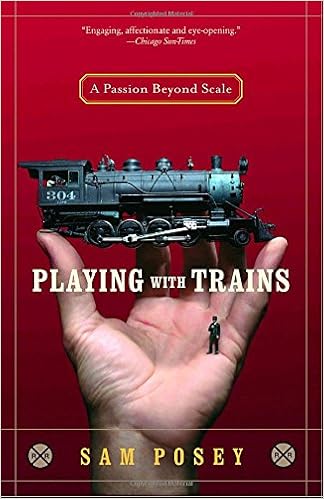
How'd I get on this topic you ask? Well, week before last I had to have a medical test done and the doctor performing said test is notorious about being late. So I brought a copy of Sam Posey's book Playing With Trains. At one point in the book the author visits the layouts of Tony Koester and Malcolm Furlow. The two are both famous modelers whose approaches to the hobby are 180 degrees apart. Mr. Koester a staunch prototype modeler while Mr. Furlow was a freelancer who saw the layout as a form of artistic expression. There's nothing wrong with either approach.

While I'm quite familiar with Tony Koester since I always enjoy his Trains of Thought column in Model Railroader, I was very curious about Mr. Furlow. So I Googled him. What I found was a blog post that infuriated me.  Another model was wondering about Mr. Furlow and reached out to him. Here's what he had to say:

"I quit the hobby because most folks in it that I knew except for the likes of John Olson, and the work of John Allen, everyone else seemed a bit too tight-minded. I could not believe the anger that was associated with my participation in the hobby. I had a lot of admirers of my work in trains but the bombardment of hate mail just got ridiculous."

Hate mail? Really? If you're so perturbed by another modeler's approach to the hobby you'd write hate mail, I have to know, who the hell do you think you are? You need to get over yourself. Your way works for you and Furlow's way works for him. Just because you do model railroading a certain way does not make you God's gift to the hobby and being dogmatic about your approach to it does more harm than good by scaring off potential new hobbyists.

I've seen some spectacular layout that are strict models of prototypes like Jack Burgess' phenomenal Yosemite Valley (link). I've also seen some exceptional layouts that are purely freelanced yet operate in prototypical manor like Allen McClelland's legendary Virginian & Ohio and Dick Elwell's Hoosac Valley. And then there are folks like my Dad who just wants a place to run and display his childhood Lionel Trains and accessories.

As for me, my approach is somewhere between that of Tony Koester and Malcolm Furlow. I try to follow a particular prototype in a set time period. But, I do take some creative liberties. My intent is not to make a 1:160 scale carbon copy but rather to capture the basic flavor of places like Gallitzin, PA. This works for me, but it may not work for you and that's fine. After all, at the end of the day, we're just, as Sam Posey put it, playing with trains.

Monday, August 14, 2017

Model Railroading Items That are Slowley Going Extinct

As an add-on to my last post about attracting young people to the hobby, I think it's important to not the hobby is not dying. In fact, a podcast provided by a reader of this blog (Hi Joe!) provided some real insight into the state of the hobby. However, as model railroading evolves some elements of the hobby are dying. So here's a list of things I see as slowly going extinct. Again, I don;t have any stats to back this up, merely my own observations.

1. Brick and Mortar Hobby Shops:

Let's start with the obvious. Hobby shops are dying a long, slow death. The rise of mail-order firms in the 1990s and then online shopping in the 2000s have done them in. Model manufactures going to the "we'll make the model when we get enough preorders" business model hasn't helped either.

2. Rapido and Horn Hook Couplers:

It seems to me, at least in n scale that most new models come with some form of knuckle coupler. Most of the Rapido-equiped cars I've had to convert in the last few years have been train show or ebay purchases.

3. Brass Locomotives:

Model manufacturers seems to be introducing more and more road-specific power, eliminating the need for brass. The quality and detail level of plastic models has also improved considerably over the years.

4. Locomotives that don't support DCC:

More and more it seems manufacturers are coming out with decoder-equipped locomotives. DCC is becoming ever more popular. I believe in the next few years all locomotives will have either a dual-mode decoder or at least be DCC-ready. I believe we will also see an increasing number of Bluetooth locomotives in the more distant future.

5. O-Gauge Tubular Track:

Yes, it's horribly unrealistic, but nothing conjures up images of Christmas moring like this track. Lionel discontinued it in 2016. However, Williams by Bachmann and Menards are still making it. But with most hobbyists in 3-rail O-Gauge opting for either Gargrave or Atlas, I don;t see much of a future for the old track.

Saturday, August 5, 2017

Attracting Fresh Blood

My son enjoying his Brio trains. Hopefully his interest continues and Brio can give way to Lionel.
A topic of many forum flame war is attracting young people to the hobby. Threads on this topic always get to be something of a broken record with such played-out hits as: "young people want everything ready made and don't want kits!" "The hobby is too expensive," "Kids can't put down their electronics," and so on. Then the young people on the forum more often than not start pushing back, things get ugly, the thread gets locked and nothing is accomplished. As a young-ish person (I'm 33), let me address some of the above points and offer my own two cents worth.

The first criticism that often gets heaped on younger modelers is we're impatient and we want things ready to run. We don't want to assemble kits or scratch-build. Baloney! I say! I love putting structure kits together and taking the time to paint them and make them look appropriate for the era and locale. I would love to scratch build more but my skills are sadly lacking. That brings me to another point, not everybody is good at scratch-building and having the ready-to-run stuff makes the hobby more accessible.

Then there's "the hobby costs too much." I know, model manufacturers aren't exactly giving the stuff away. But there are still affordable trains out there. When I was a kid in early 1990s, most toy stores still carried trains. A new HO freight car set you back $3. Adjusted for inflation, that's about $5.32 today. No the cars weren't super detailed or road specific and they had the old horn hook couplers. But you could buy them on a week's allowance.

As for the fact that kids can't put down their electronics, this might be a valid point. It's not so much electronics as it is other toys in general. Lionel found themselves losing the interests of children back in the 1960s. Railroads for a lot of the country aren't visible and children aren't aware of the role they play in everyday life. On top of that many local hobby shops have long since gone out of business.

We know what the problem is, now how do we fix it? My son loves Thomas the Tank Engine and Chuggington. When we get stuck at a grade crossing we couldn't be happier. My wife and I bought him Brio set and loves playing with it. If he continues to show interest, I'll encourage him .Same goes for my daughter.

Encouraging that early interest may very well be the key to getting more kids involved in the hobby. Shows like Thomas and Chuggington may create that initial interest but all too often, I believe parents think it's something their child will outgrow and they don't encourage them. So how do we reach out to these parents? I really don't know. I do know model railroading has a lot more offer than video games. It's great teacher. It taught me woodworking, electricity, how use tools and fostered and interest history.

I do believe things aren't as dire as a lot of the old timers make them out to be. When I volunteered at the Hub City Railroad Museum, I was the oldest among the sizable group of young people there. Some of them will hopefully become part of my operating group. Many parents brought young children through and they were enthralled by the museum and the chance to see real Norfolk Southern freight trains roll by too. I try my best to mentor fellow modelers and help them out anyway that I can. And there's still a lot I have to learn.

Wednesday, December 14, 2016

Endless Summer?

One question I get asked from time to time is "why don't you build a winter layout?" Well that's a no brainer. Model railroading for many of us, myself included is kind of an escape from our daily lives. And since most of my model railroading activity occurs in the winter months, where even here in the Palmetto State, the world is a grey, bleak, depressing wasteland; why on Earth would I want to model it? Frankly, I'd much rather come upstairs, flip on the lights and see my favorite part of Pennsylvania on a summer day, and it's warm.

Also, part of the reason I chose this area to model was I spent many a happy hour railfanning there with my dad. And always during the summer. So the summer setting is definitely evocative of those memories.

Now that said, I did briefly toy with the idea of doing an autumn-themed layout with all the brightly colored foliage. However, that would've required making hundreds of different color puffball trees. I never would have made this amount of progress if I'd modeled the fall.